Forget the Trail Map: Why Gen Z Is Wandering Through Forests With No Destination and Feeling Better Than Ever
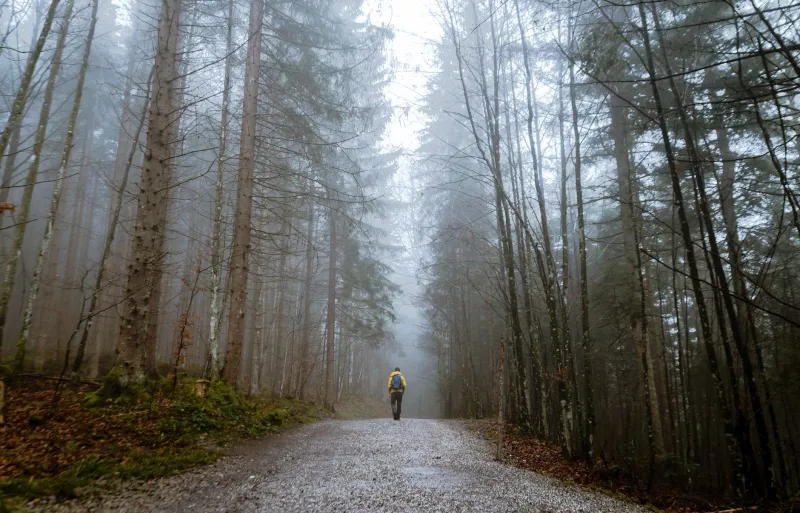
The trailhead parking lot at a state park outside Asheville, North Carolina, on a Tuesday morning looks different than it used to. There are still the serious hikers with trekking poles and GPS watches. But mixed in with them, increasingly, are people who arrive with nothing but themselves — no earbuds, no fitness tracker, no plan.
They're not training for anything. They're not trying to hit a step count. Some of them aren't even sure where they're going.
Ask them what they're doing and they might say "forest bathing," or they might just shrug and say they needed to be outside without their phone telling them what to do with it.
Either way, they've found their way to one of Japan's most quietly influential wellness exports — and they're using it to recover from something that didn't exist when shinrin-yoku was first developed in the 1980s: the specific, grinding exhaustion of being permanently online.
What Shinrin-Yoku Actually Is
The Japanese Ministry of Agriculture, Forestry, and Fisheries coined the term shinrin-yoku in 1982 — literally "forest bathing" — as part of a national public health initiative. The idea was elegantly simple: spending deliberate, unhurried time among trees, engaging your senses without agenda, produces measurable physiological benefits.
And the research has been remarkably consistent over the decades that followed. Studies out of Japanese and Korean research institutions found that time in forest environments lowers cortisol levels, reduces blood pressure, improves immune function (specifically natural killer cell activity), and decreases markers of anxiety and depression. The effects are distinct from general exercise — you get them even when you're barely moving.
The mechanism appears to be partly sensory. Trees release volatile organic compounds called phytoncides, which have demonstrated immune-boosting effects when inhaled. But researchers also point to something harder to quantify: the particular quality of attention that forests demand, and allow.
Not focused attention. Not the kind that requires output or decision-making. Something closer to what psychologist William James called "involuntary attention" — the effortless, drifting awareness that kicks in when you're not trying to accomplish anything.
That distinction matters more now than it ever has.
The Attention Economy Has a Bill, and Gen Z Is Paying It
Here's the thing about growing up with smartphones: you never really learned what boredom feels like. Every idle moment has been filled since before you could drive. Waiting rooms, bus rides, the three minutes between classes — all of it colonized by content, notifications, algorithmically optimized stimulation designed to keep your attention engaged at maximum capacity.
The result, for a lot of Gen Z adults now entering their twenties and thirties, is an attention system that's genuinely exhausted. Not from doing too much, but from never being allowed to do nothing. The concept of directed attention fatigue — a state in which your capacity for focused thought degrades from overuse — maps eerily well onto what a lot of young Americans describe when they talk about burnout.
"I couldn't read a book for more than ten minutes," says Theo, a 24-year-old in Denver who started going on what he calls "aimless walks" in the foothills near his apartment last year. "Not because I was tired. I just couldn't... stay with anything. My attention kept wanting to jump."
Shinrin-yoku, it turns out, is almost precisely calibrated to restore what the attention economy depletes.
Why This Isn't a Hike
This is the part that trips people up, especially in a culture that's turned outdoor activity into another performance domain. Shinrin-yoku is not hiking. It is emphatically, deliberately not about distance, elevation gain, personal records, or scenic destinations.
A certified shinrin-yoku guide in Northern California describes the typical session to first-timers this way: "We walk maybe a mile in two hours. Sometimes less. We stop constantly. We sit on the ground. We look at things that have no practical significance. We breathe."
The goal — and even calling it a "goal" slightly misrepresents the practice — is sensory immersion. What does the bark feel like under your hand? What do you hear when you actually stop moving and let the forest fill your ears? What does the light look like filtering through leaves right now, not in a photo, but with your actual eyes?
This is where the practice diverges most sharply from how Americans typically approach nature. We've turned the outdoors into a venue for achievement. Hiking apps track your pace. Social media rewards summit photos. Even "wellness walks" often come with a podcast or a playlist, which means you're still consuming content — just with trees in the background.
Shinrin-yoku asks you to consume nothing. To produce nothing. To simply be a sensing creature in a living environment.
"That's incredibly hard for people at first," the guide notes. "About twenty minutes in, most people start to fidget. They want to check their phone. They want to do something. And then, somewhere around forty minutes, something shifts. You can see it happen."
The Science of Aimless Wandering
Researchers studying restorative environments have identified what they call "soft fascination" — the gentle, low-demand engagement that natural settings provide. Unlike the hard fascination of a screen or a deadline, soft fascination allows your directed attention systems to rest while your mind still has something pleasant to occupy it.
Clouds. Moving water. The pattern of moss on a rock. A bird you can hear but not see.
This is what forest environments are uniquely good at providing, and it's almost the exact opposite of what a smartphone provides. The forest makes no demands. It sends no notifications. It does not optimize for your engagement.
For a generation that has never known a world without algorithmic content curation, that absence is genuinely novel. And apparently, genuinely healing.
How to Actually Do It
You don't need a guide, a certification, or a national forest. A city park with mature trees works. So does a botanical garden, or even a tree-lined street if that's what you have access to.
The practice is the point, not the setting. Leave your earbuds at home — or at minimum, in your pocket. Don't track your steps. Don't set a route. Walk until something catches your attention, then stop and pay attention to it. Sit down somewhere that feels comfortable and don't immediately take a photo.
Give it at least an hour the first time, because the first thirty minutes are often just decompression. The interesting stuff happens after your nervous system stops waiting for the next input.
Theo, the Denver wanderer, now goes out two or three times a week. "I can read again," he says, a little surprised by the simplicity of it. "I can sit through a whole meal without checking my phone. I don't know exactly what changed, but something did."
The Japanese have known about this for forty years. The trees, for considerably longer.